
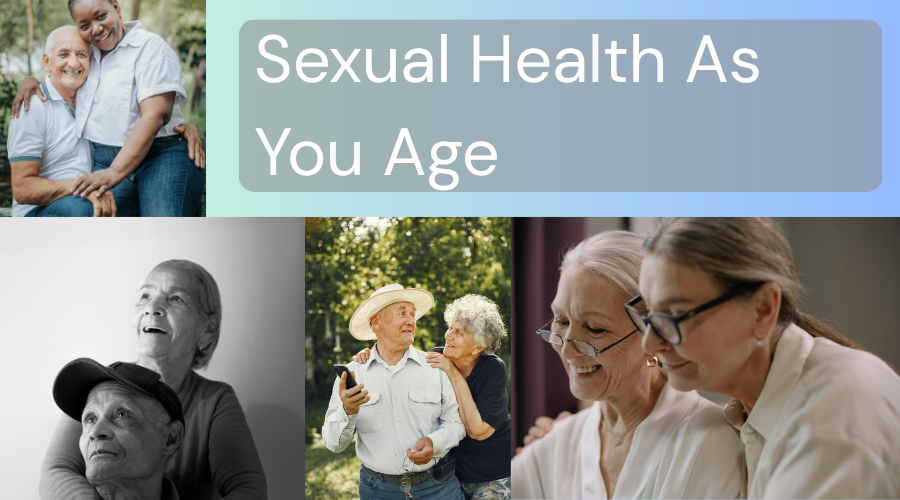
Sexual health as you age
Learn how sexual health can change with age and ways to maintain intimacy and well-being.
Download this page as a PDF to save, print, or share.
Download printable PDFDeveloped with:
Dr. Lori Brotto
Registered psychologist, researcher, professor, and director of the UBC Sexual Health Research Laboratory. Dr. Brotto is a leading figure in sexual health research and a frequent media spokesperson. She has won numerous awards for her books, research, and leadership in public health education.
Dr. Walter Wittich
Associate professor at the School of Optometry, Université de Montréal. Dr. Wittich holds a Masters in Psychology and a PhD in Visual Neuroscience. He is recognized as a leading researcher, teacher, and defender of human rights for people with disabilities.
Reviewed by:
Dr. Lori Brotto, PhD (Psychology)
Dr. Walter Wittich, PhD (Visual Neuroscience)
Dr. Eli Puterman, PhD (Psychology)
Last reviewed: January 2026
Disclaimer
This information is for general education purposes only and does not replace advice from a healthcare professional.
Written by:
Laura Busheikin
What you need to know
Sexual health is part of overall health, not just a lifestyle or personal issue.
As we get older, our sex life can improve, change, face challenges, or all three.
The health care system offers many ways to support our sexual health. Evidence show that these treatments usually work. Some treatments involve medication, and many do not.
People can enjoy a satisfying sex life at any age.
Know your terms
These terms are often used in eye care. Here’s what they mean in plain language. Some terms have legal definitions and some more generally describe someone’s vision experience.
The World Health Organization defines Sexual Health as “…a state of physical, emotional, mental, and social well-being in relation to sexuality.” It is measured by personal satisfaction and comfort, rather than by instruments and lab tests.
Sexual Health
Means people can have pleasurable and safe sexual experiences, free of violence, pressure, and discrimination
Is more than the absence of problems or dysfunction
Is rooted in a positive and respectful approach to sexuality and sexual relationships
Sexual health care is related to, but is not the same as, reproductive health care and the prevention and treatment of sexually transmitted infections (STIs). STIs are becoming more common among older adults. If you have symptoms or concerns, talk to a health care provider.
Steps you can take today
Take care of your body
When our strength, balance, or mobility decrease, our sexual function and satisfaction can suffer. You can support physical wellness by staying active, preventing falls, and asking your doctor or nurse practitioner about getting a bone density test (BMD).
Limit alcohol
Alcohol can make it harder to feel aroused, get and keep an erection, and have an orgasm. Some people find a small amount helps them relax. This may be okay unless you have other health reasons to not consume alcohol. However, studies show that larger amounts of alcohol reduce sexual function and satisfaction.
Release stress
Stress contributes to sexual dysfunction, including low desire, difficulties with orgasm, and pain during sex. You may find it helpful to:
Ask your health care provider about managing stress
Talk with a counsellor
Learn mindfulness or other relaxation techniques
Take care of your mental health
Depression and sexual dysfunction often occur together. Ask your doctor or nurse practitioner about counselling and other mental health supports. Read more on our Depression page.
Get a good sleep
Good sleep supports heart health, mood, energy, and sexual health. If sleep is a challenge, talk to a health care provider about ways to improve it.
Taking Care of your sexual health can support:
Sexual activity with a partner or on your own
Satisfaction, pleasure, desire, and arousal
Orgasms and erections
Reduced pain during sex
Communication of your desires and needs
Four keys to a better sex life
Learn
Learning about sex can help you feel more confident and comfortable. You can find answers to questions and ideas for new approaches.
You might read an article or book, listen to a podcast, watch a documentary, or take an online course. See Resources below for suggestions.
Communicate
Research overwhelmingly shows that couples who talk about sex report higher levels of sexual satisfaction. Communication matters in long-term relationships and when forming new ones.
As you age, you may need to speak up about pain or discomfort or about changing levels of energy, desire, and arousal.
- Talk about sex both in and especially out of the bedroom.
- Plan ahead for what you want to say.
- Focus on shared goals like pleasure, intimacy, and satisfaction.
- Talk about what works and what could work better.
- Read a book or listen to a podcast on sex together.
- Shop for toys, accessories, or sexual wellness products together.
Be Open to Change
As you age, you may need to do sex differently. This could mean:
- Slowing down.
- Changing how you position or support your body.
- Rethinking what sex means. For example, some people were taught that sex must include an erection, penetration, and orgasm. If these are no longer possible or desired, you could be pleasantly surprised to discover other sources of sexual pleasure.
- Realizing that sexual arousal may take much longer. Think about arousal in terms of hours or days, not minutes.
Learn About and Consider Using Sexual Wellness Products
Additional lubrication can help reduce pain and enhance pleasure during sex. There are different types of lubricants, including silicone and water-based lubricants.
Silicone lubricants are longer lasting, water-resistant, and feel silky to the touch. But they can also stain sheets and damage toys, such as dildos.
Water-based lubricants are easier to clean and safer on toys. Water-based lubricants dry out quickly and need to be reapplied frequently.
Oils, such as baby oil, are not compatible with condoms and are NOT recommended for use.
Research shows that older adults are increasingly using sexual devices, such as vibrators, to enhance pleasure in both solo and partnered activities. These tools also help people with mobility limitations.
Challenges to sexual health as we age
Physical changes
Changes in desire and arousal
Pain during sex
Difficulty getting and maintaining an erection (erectile dysfunction)
Trouble reaching orgasm or having a blunted orgasm response
Health conditions such as heart disease, high blood pressure, diabetes, or injuries that can reduce effort and stamina
Psychological and life changes
“Empty nest syndrome” when children leave home
Changes in relationships due to death or illness
Retirement and shifts in identity or routine
Financial stressors
Social barriers
Negative messages about aging and sexuality
Pressure to age in unrealistic ways—we might feel if we are not running marathons in our 70s and 80s, we have failed
Cultural norms that discourage talking about sex
Negative attitudes and policies towards sexual and gender minorities—for instance, sometimes, LGBTQ+ couples can’t find assisted living space together as a couple
Health care system barriers
Difficulty finding a health care provider trained in sexual health
Lack of comfort among some care providers
Stereotypes and bias among some care providers
For people who are 2SLGBTQIA+, people with disabilities, and others who face discrimination, these barriers can be particularly challenging. Finding respectful, knowledgeable care may take extra effort. See Resources below for support.
Finding treatment
All of the challenges listed above can improve with treatment. Sometimes, this involves taking medication such as Viagra or Cialis to help men maintain erections or Addyi for women to increase libido (sexual desire). Often, treatment is psychological and behavioural.
A psychologist trained in sexual health can help you:
Work through difficult feelings
Learn new physical skills so you can adjust to changes in health and mobility
Overcome shame and fear
Develop better communication skills
Navigate dating or long-term relationships
Develop new approaches to sex after illness or injury
Help you challenge avoidance behaviour
When to look for help?
If you are feeling concerned about your sexual health in any way—physically or emotionally— then you should seek help. Your sense of satisfaction and comfort is more significant than any particular symptoms.
Where to look for help?
Start by talking to the health care provider you trust the most. A family doctor or nurse practitioner should be able to provide basic information, encouragement, and possibly treatment for some conditions. If you do not have a regular care provider, community clinics or free on-line or phone services may help.
Your care provider may refer you to a specialist, often a psychologist specializing in sexual health. Wait times are common.
Do I have to pay for treatment?
In British Columbia, provincial health insurance (MSP) does not usually cover psychologists. If cost is a barrier, ask your health care provider about low-cost or free options.
A success story
Anita was in her early 70s and had been single since her partner died 20 years earlier. She avoided dating during those two decades. But lately, she was feeling more confident and ready for a companion.
The idea of dating brought up fears. Anita had trouble imagining physical intimacy with someone new. What if she tried to engage in sexual activity, and nothing worked? She was taking several medications for chronic asthma—how would that impact her body?
The whole topic felt awkward to Anita, but she decided that fear shouldn’t stop her. She called a psychologist specializing in sexual health.
At the appointment, Anita learned a lot of new information. The psychologist talked about how desire and arousal work. Also, Anita practiced asking a partner for what she wanted. This was new to her. She’d never done it in her previous relationship and was worried that she would come across as pornographic or too assertive. Using role play with her therapist, Anita found new ways to express her desires.
Treatment also included cognitive-behavioural therapy, which is a way of changing negative thoughts that hold us back. Anita was able to let go of damaging and untrue beliefs such as “it’s not possible to go back to sex after 20 years of abstinence” and “no one will find me attractive.”
After three therapy sessions, Anita began dating. She continued going to sex therapy sessions and doing her homework exercises, and a few months later, she started having sex again. In spite of her earlier fears, everything did work. The result was satisfaction, pleasure, and intimacy for Anita and her partner.
Learn more: what research tells us
Researchers are still learning about the relationship between sexual health and overall health. While not every detail is fully understood, strong evidence shows the two are connected.
Large studies have found that, on average:
Men who continue to have sex as they get older tend to live longer
Women who report higher levels of sexual satisfaction tend to live longer
Older adults who engage in sexual activity have better cognitive health (thinking and memory)
Older men and women who report more sexual satisfaction also have better overall health
These findings don’t tell us about causation: does good sex promote good overall health or is it the other way around—good health promotes good sex? Or both? Or are good overall health and positive sexuality both caused by other things, like education, financial stability, and strong social connections? Researchers don’t know. But they do know that sexual health is part of general well-being.
Resources
Books, podcasts, online resources
Come As You Are, by Emily Nagoski—book
Challenges cultural myths about sexuality and shows the way forward to a satisfying sex life, whatever that means to each individual. Based on science and research, aimed at the average reader and mainly women.
EnduringDesire: Your Path to Lifelong Intimacy, by Michael E. Metz and Barry W. McCarthy—book
Uses real-life examples and offers strategies to help enhance and maintain sexual desire and intimacy in long-term relationships. Aimed at couples from their 20s through their 80s.
Magnificent Sex: Lessons from Extraordinary Lovers, by Peggy J. Kleinplatz and A. Dana Menard—book
Provides strategies for people who want to make erotic intimacy grow over the course of a lifetime. Supports diverse relationships, varied sexual interests including kink, and a range of health conditions. Includes material specifically for LGBTQ individuals and couples.
The Glma Handbook on LGBT Health, by Hector Vargas, Jason S. Schneider, Vincent M.B. Silenzio, and Laura Erickson-Schroth—book
A thorough handbook which includes material about sexual well-being.
Sex Advice for Seniors—podcast
Become Passion—online course for couples
Healthlink BC—Sexuality and physical changes with aging—website
Clinics
B.C. Centre for Sexual Medicine at Vancouver General Hospital
604-875-4705
Provides consultation and short-term treatment recommendations. You will need a referral from your doctor. Services are covered by provincial health insurance (MSP).
Free and low-cost support
Sex Sense information service
A free, confidential sexual health service by phone or email. Inclusive, trans- and queer-affirming, and available to people of all ages and abilities.
1-800-739-7367 throughout BC or 604-731-7803 in the Lower Mainland
Or send an email using their on-line portal
2SLGBTQIA+ Counselling Program
Offers up to ten sessions with a registered clinical counsellor
Free or reduced-cost
Matches you with a counsellor trained in sexual health if you ask for this
Apply by filling out the online form
Run by the non-profit organization Qmunity
Confidential, inclusive, and affirming
First Nations resources
The First Nations Health Authority: Sexual Health is for Everyone
Grounded in Indigenous perspectives, values, and culture
Website with information and links to programs
Phone number for the “Virtual Doctor of the Day” program
Need more help?
🟦 HealthLink BC
📞 Call 811 (24/7)
Health information and advice from registered nurses, dietitians, pharmacists, exercise professionals, and health service navigators.
🟩 BC 211
📞 Call 811 (24/7)
Community programs, financial assistance, housing, transportation, caregiving, resources, and more.
Available in over 240 languages