
Stay healthy by avoiding frailty
Frailty isn’t an inevitable part of aging. Find practical ways to stay strong, independent, and engaged as you get older.
One of the best things we can do to stay healthy and independent as we age is learn about frailty. Knowing what frailty is, and learning how to avoid it, can help prevent many illnesses and increase our quality of life at any age.
Download this page as a PDF to save, print, or share.
Download printable PDFDeveloped with:
Dr. Grace Park
Assistant professor at the UBC Faculty of Medicine, researcher, founder of the Pacific Regional Centre for Healthy Aging, medical consultant for United Way BC, and leader in the field of social prescribing.
Reviewed by:
Grace Park, MD, CCFP, MBA, Professor, researcher
Eli Puterman, PhD, Professor, researcher
Last reviewed: May 2026
Disclaimer
This information is for general education purposes only and does not replace advice from a healthcare professional.
Written by:
Laura Busheikin
What you need to know
Older people with frailty:
Often take longer to recover from illness, falls, and injuries
Are more likely to be hospitalized and to stay in the hospital longer
Are more likely to need long-term care
Are more likely to have shorter lives
Frailty doesn’t happen to all older adults. Many people live long, productive lives without experiencing frailty.
You can prevent, improve, or slow frailty. Research shows that without action, frailty typically gets worse, which can cause serious problems, so taking steps to avoid frailty is key.
Know your terms
Frailty isn’t an illness or disease—it’s what happens when someone’s overall health gradually gets worse.
Frailty doesn’t look like one symptom. Instead, doctors will identify frailty when several of the following are present:
Weakness
Muscle loss
Increased tiredness
Problems with memory, clear thinking, and concentration
Slow recovery from setbacks
Problems doing things you used to be able to do (physically, mentally, and socially)
Unintentional weight loss
Steps you can take today
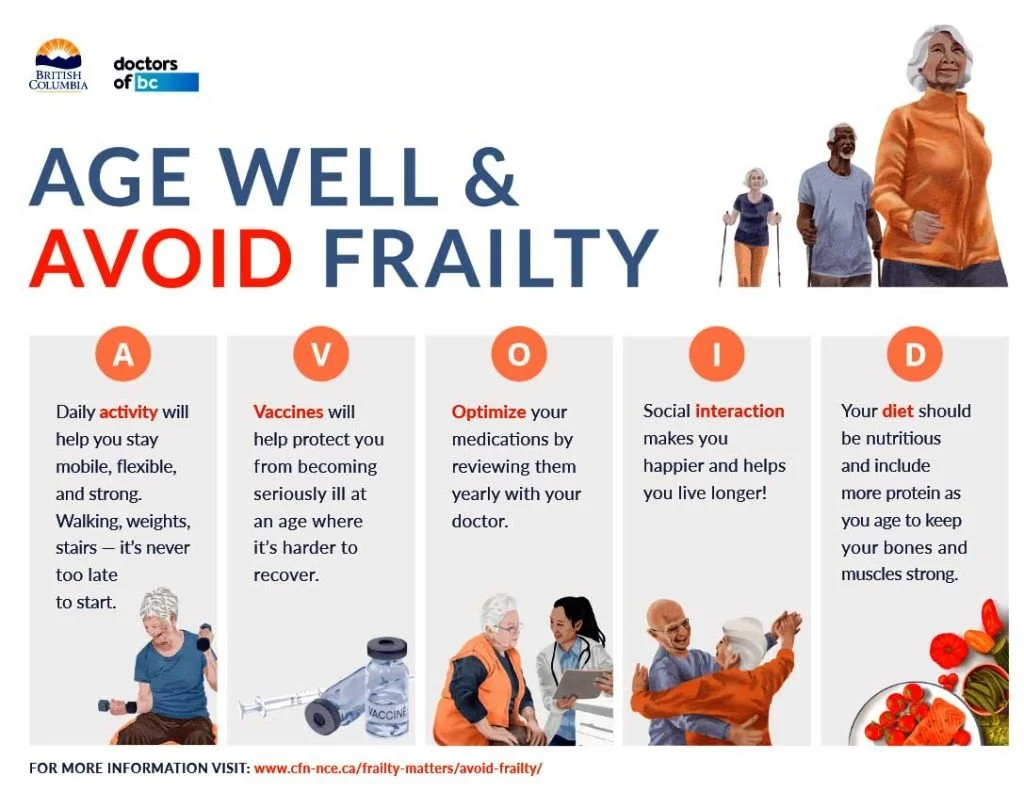
The AVOID Frailty framework: Activity, Vaccinate, Optimize medications, Interact, and Diet. The five actions are explained below.
The acronym AVOID offers a simple framework for preventing frailty:
Activity
Being active every day helps you stay mobile, flexible, and strong. All movement helps, including sports, fitness, fishing, chair yoga, walking, and bed exercises. Learn more at our Staying active page.
Vaccinate
Vaccines help protect you from getting seriously ill at an age when it may be harder to recover.
Optimize medications
Ask your doctor or nurse practitioner to review your medications every year and anytime your health situation changes. Make sure you follow medication instructions correctly.
Interact
Being with other people and having friends and family in your life helps you live longer. Learn more at our Staying connected page.
Diet
Choose healthy foods, including extra protein and vitamin D as you age, and drink enough fluids. Learn more at our Healthy eating page.
Start with one simple step
An easy way to begin preventing frailty is to take a quick online or phone frailty assessment from the Canadian Frailty Network.
This assessment starts with a short quiz. The results will help you and your health care provider know what you can work on. You can take the quiz again in six months to see if your results have improved.
Myth vs. Fact
If your parents became frail as they aged, you will too.
Frailty is not inherited. Genetics play only a very small role—less than 20%—in whether someone experiences frailty. Lifestyle, medical care, and having a supportive community all make a big difference.
Only very old people experience frailty.
While frailty is more common in older adults, people of any age can experience frailty, often caused by illness, injury, or poor nutrition.
What the numbers say: How prevention helps
People who took a frailty prevention program that provided free telephone coaching showed the following improvements after six months:
Ability to walk independently went up by 30%.
Balance improved by 29%.
Health attitude improved by 59%.
People exercised 67% more than before the program.
If no prevention takes place, a person’s level of frailty typically increases each year and can double in 15 years.
Resources
Websites and programs
Offers education, a tool to assess your risk for frailty, a personalized plan, and coaching
Offers free health programs for adults with one or more ongoing health conditions. Available in person, online, by telephone, or by mail. , with options for Chinese, Indigenous, and Punjabi communities
Peer coaching
Contact Gurpreet Sandhu at gurpreetsandhu1@uvic.ca | 604-946-0195
One-on-one coaching using AVOID Frailty strategies to slow down and prevent frailty. Participants need to be 65+ years old and live in the Fraser Health area
Self Management BC also provides information and training on becoming a peer coach
Resources for First Nations, Inuit, and Métis Peoples
Keeping Our Nlakapamux Elders at Home: Learn about an initiative to combat frailty and keep Elders engaged in their community
Canadian Frailty Network: Indigenous Health: Information and resources
Need more help?
🟦 HealthLink BC
📞 Call 811 (24/7)
Health information and advice from registered nurses, dietitians, pharmacists, exercise professionals, and health service navigators.
🟩 BC 211
📞 Call 811 (24/7)
Community programs, financial assistance, housing, transportation, caregiving, resources, and more.
Available in over 240 languages