
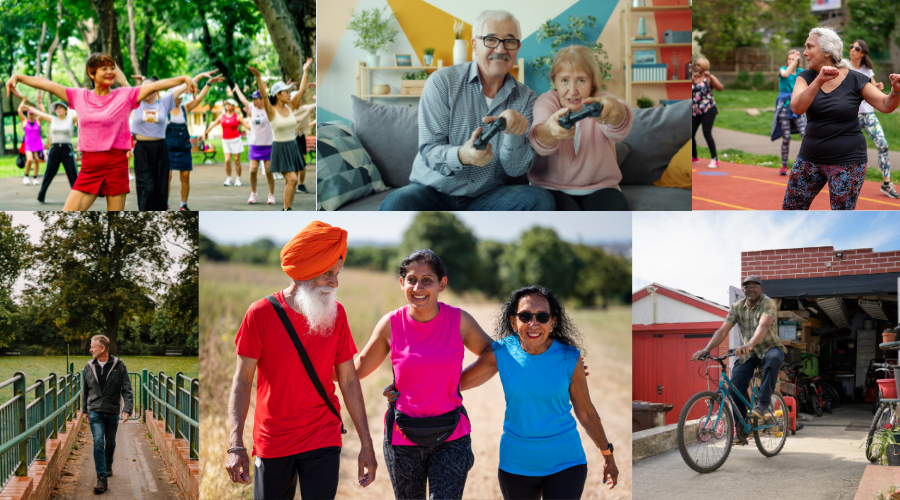
Staying Active
Discover simple ways to move more, stay active, and support your mobility as you age.
Download this page as a PDF to save, print, or share.
Download printable PDFDeveloped with:
Dr. Maureen Ashe & Dr. Sandra Hundza
Dr. Ashe and Dr. Hundza are physiotherapists, professors, and researchers specializing in mobility.
Reviewed by:
Maureen Ashe, PhD (Professor, researcher, physiotherapist)
Sandra Hundza, PhD (Professor, researcher, physiotherapist)
Grace Park, MD, CCFP, MBA, Professor, researcher
Eli Puterman, PhD (Professor, researcher, kinesiologist)
Last reviewed: January 2026
Disclaimer
This information is for general education purposes only and does not replace advice from a healthcare professional.
Written by:
Laura Busheikin
What you need to know
Staying active can help you
Live longer
Stay out of hospital
Avoid falls
Continue to live independently
It can also
Boost your mood
Improve your sleep
Sharpen your focus
Steps you can take today
Make movement fun
Lifestyle changes work best when they suit you. Think about your budget, your energy levels, your support system, and what you enjoy doing.
Try linking a new activity to something you already love. If you like nature, join a birding or walking group. If you like music, try a dance class, or listen to music while you ride a stationary bike. If there is an activity you used to like that you can no longer do, find something similar.
If you have specific needs or goals, you can work with a physiotherapist or kinesiologist. You don’t need a doctor’s referral. See Help is available below.
Make it social
Joining a group or having a buddy for activity means you are more likely to stick with it. If you have a friend who is active, ask to join them. Check out your local community centre or seniors’ centre. See Resources below for help finding opportunities in your community.
Don’t compare yourself to others
There are 85-year-olds trying chair yoga, 65-year-olds learning how to use a walker, and 75-year-olds hiking up mountains. All these people are success stories because they are staying mobile and active.
Look beyond exercise
All movement has health benefits. Gardening, fishing, fixing things around the home, walking the dog, cooking, and cleaning all keep you fit.
Things you do as part of daily life, like making a snack, doing laundry, or walking to the bus stop count as activity. If you spend most of the day sitting or lying down, just moving around the room helps.
Make your home safe
Learn how to make your home safer and easier to move around. Learn more on our Your home as you age page.
Work with a physiotherapist or occupational therapist to find the right mobility aids (canes, walkers, crutches, grab bars, etc.) if needed. Ask for tips on how to use them. Also, ask for support for getting around easily outside your home.
Use motivational tools
The science of motivation tells us that most people stay active when they find activities that are fun and feel good. Also, for many people—but not everyone—plans, goal setting, and rewards provide motivation.
If you are the type of person who likes to set goals, use a pedometer (a device that counts your steps) or a smart watch (like Apple watch, Fitbit, etc). Track your current steps, set a 10% goal increase, and watch your numbers go up.
There are plenty of fitness apps that make activity tracking easy and fun, or you can keep things simple with a paper tracking chart pinned to your fridge. You could call a friend or family member to tell them about your latest success. Some people give themselves little treats when they reach goals.
If tracking is not your thing, think back to a period of time in your life when you moved your body more than you do now. This could go all the way back to childhood or when you went to activities with your children.
Why did I like that activity?
What was fun about it?
Who can I do that activity with now?
Look for an activity that will be easier to get to more often because it’s with someone else or a group of other people, or find something that just makes you feel good inside.
Support better mobility with healthy living
This improves your energy and mood which makes it easier to engage and be active.
Learn about healthy eating →See an eye doctor regularly and wear your glasses when you need them.
Learn about eye health →Get your hearing tested regularly and wear hearing aids if you need them.
Ask your doctor or nurse practitioner if any of your medications might make activity difficult. If so, explore options.
When researchers look at what behaviours are linked to living a long, healthy life, social engagement comes out as number one.
Learn about social connection →Help is available
You can meet with a physiotherapist, kinesiologist, or other health care professional in your community. You don’t need a doctor’s referral to see them.
They will work with you on your personal needs and wishes. For instance, perhaps you want to feel steadier on your feet (improve balance). Perhaps you wish you could get to your book club on your own. You might work one-on-one with them or in a group.
Find this support through your local recreation centre, ask your doctor, or contact BC 211.
Getting mobile again after a setback
Life has its ups and downs. These affect our activity levels at any age. Luckily, there are ways to get moving again.
Recovering from surgery and hospital stays
Mobility and general physical health are the number one influence on how well people recover after a hospital stay. They also help determine whether people go back to their homes or into long-term care facilities. You can influence this.
In the hospital
Anything you do to improve this will help your recovery. Let staff know you want to stay as mobile as possible. Ask for their help and advice.
You can do bed exercises, if appropriate. If you are able to walk around, find a destination in the hospital you can visit each day.
Going home
As you prepare to leave the hospital, your health care team will work with you to create a discharge plan. Once back home, follow the discharge plan.
And don’t be shy to ask the people in your life to help keep you active.
Getting moving after a pause
A vacation, a change in the weather, an exercise class being cancelled, or a walking buddy moving away can mess up your routine.
Look for a new class or a new buddy. Switch activities. You may simply need to start again, but slowly.
Myth vs. Fact
Losing mobility can’t be avoided as you age.
This is not supported by evidence. Mobility at 80 might not look the same as it does at 20, but with the right support, most people can stay mobile their whole life.
Once you lose mobility, you can’t get it back.
If you hit a setback—a hospital stay, a change in health, or simply a time where you didn’t manage to stay active—you can bounce back.
You must exercise.
The physical and mental health benefits of exercise are huge. But if you have never liked exercise, there’s a fair chance you won’t like it as you age. If that’s you, don’t give up.
You can stay mobile—you simply need to move. See Look beyond exercise above for ideas.
Also, you can take lifestyle and health care actions that will make it easier to stay mobile.
What research tells us: The dangers of sitting too much
Sedentary behaviour—too much sitting—is linked to a wide variety of diseases. It’s becoming a bigger problem in our society, thanks mainly to the role of technology in our lives.
Finding time for movement—such as a walk, fitness class, gardening, or yoga—will help offset the impact of too much sitting. But researchers are finding that exercise isn’t always enough.
Then mostly sitting
These adults exercised, but spent most of the rest of their day sitting.
Sitting broken up with movement
These adults regularly broke up their sitting time with light activity, such as walking or standing.
Exercise is important, but it’s not enough on its own. How much you move (or sit) during the rest of the day also matters.
Resources
Find programs and services in your community
An online directory where you can search for community services, education, and support
Classes
Osteofit and Get Up and Go classes
Classes offered in many community and recreation centres
Resources for First Nations, Inuit, and Métis Peoples
Be Active—First Nations Health Authority
Exercise programs, contact to many First Nations sports clubs and associations (golf, soccer, canoeing, and more), links for more information
ISPARC Move | Play | Compete – Indigenous Sport, Physical Activity & Recreation Council
Exercise guides to read and download
24-Hour Movement Guidelines for Adults aged 65+
From ParticipAction and the Canadian Society for Exercise Physiology.
Guide to Exercise from Osteoporosis Canada
Aerobic Fitness for Older Adultsand Strength Training for Older Adults
Tip sheets from Active Aging Canada
15 exercises, with diagrams and clear, simple explanations
Your Plan to Get Active Everyday!
A 32-page booklet from the Heart and Stroke Foundation which includes an activity log and tips on how to sit less
Need more help?
🟦 HealthLink BC
📞 Call 811 (24/7)
Health information and advice from registered nurses, dietitians, pharmacists, exercise professionals, and health service navigators.
🟩 BC 211
📞 Call 811 (24/7)
Community programs, financial assistance, housing, transportation, caregiving, resources, and more.
Available in over 240 languages